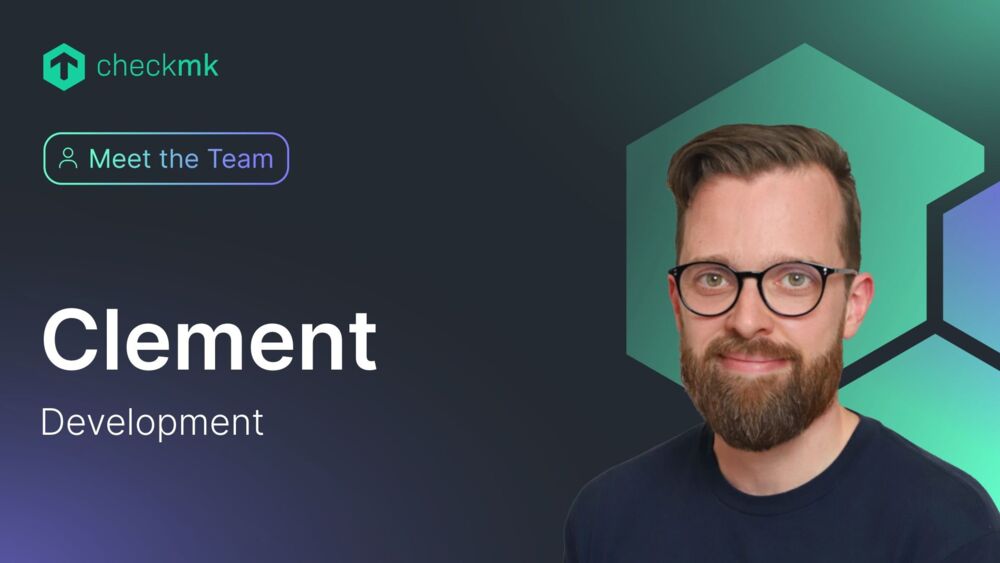
Clement Beaufils
How did you come to Checkmk? What made you decide to join?
I’ve seen my fair share of interviews and onboarding processes. I was genuinely impressed by how smooth and well organized everything felt, there was no “corporate fluff”.
The combination of a remote role in an international environment made the decision easy, and being able to visit Munich for events to see everyone is a huge plus.
What must a software product and the company behind it offer for you to remain convinced of them even after several years?
For me, it should have efficient communication, trust and the feeling that you’re having a real impact.
Checkmk has a culture that lets me be myself and allows for different working styles and diversity. This eventually led me to ADHD diagnosis and made me adapt my ways to work in ways I haven’t tried previously, impacting both my professional and personal life positively. I feel like I belong here and can actually grow.
What do you think makes Checkmk or your team in particular special?
The “no bullshit” policy and an honest, relatively horizontal environment where every voice is heard. You feel valued and involved, which is engaging. I often feel lucky and humbled to work with talented people.
One of our developers highlighted our good work-life balance. What does a healthy balance mean to you, and how do you achieve it?
Working remotely from France, flexibility is important to me. I can hit the gym, handle parenting duties or attend medical appointments without stress. If one has an “off” day, they can adjust their hours. I sometimes take advantage of this by travelling with my family on a Thursday evening; work remotely from our destination on Friday and start the weekend there when the day is finished. It makes life much easier and less tiring.
Which development tools do you prefer using, and why are they essential for your daily work?
On the infra side, I rely on Gerrit, Jenkins, Terraform, and Ansible to deploy our environment. For operations and investigations, I mostly use Python scripts and Neovim is my IDE of choice. I’ve been exploring Claude Code to assist with complex tasks, and automate the routine so I can focus on what matters.
Can you describe the typical lifecycle when working on a new software feature within a team?
My work focuses on building and operating the infrastructure of a SIEM (Security Information Event Management) while using it for security detection and investigations. I am not directly involved in the customer-facing code.
Within the Development Security Team, we operate in two-weeks sprints, using a hybrid of Scrum (structure) and Kanban (flow), sometimes called Scrumban. Absolute priority items are in our Sprints, while “stretch goals” are in a secondary list, that we can achieve if we have the time. This structure allows us to stay synced with the Developments Sprints, while remaining reactive to handle unplanned tasks like new vulnerabilities or urgent security requests.
How does Checkmk support a Security Mindset for developers?
Security isn’t a blocker here. Developers genuinely care when we ask them to implement security measures. This is something that I haven’t seen often in previous roles. We also have initiatives like internal CTFs (Capture the Flag) where developers solve security challenges by exploiting vulnerabilities on a dedicated platform. It’s a great way for them to learn through practice and develop the reflex to think like an attacker, which is essential when building new features.
How do you ensure the quality and scalability of your code?
Quality is a team effort. We have dedicated pair-programming slots in our calendars, to tackle a new problem together, think hard on a solution to a problem or to get a second pair of eyes, should it be to have some help or review a code change. For scalability, we sync daily and report our progress and workload trends to the CTO every two weeks. This pulse check helps us adapt as the company grows.
What do you value most when collaborating with other feature teams and developers?
I love the international aspect. Working with colleagues all over the world with different working styles and cultures. When I collaborate with them, I try to understand their specific challenges, and it’s an opportunity to see different aspects of our products.
Do you remember a particularly interesting, exciting or beautiful experience you had at Checkmk? If so, can you tell us about it?
The Checkmk Conference. After years as a consultant, seeing users from all over the world and meeting people who use the product I help protect made our work feel tangible and valued.