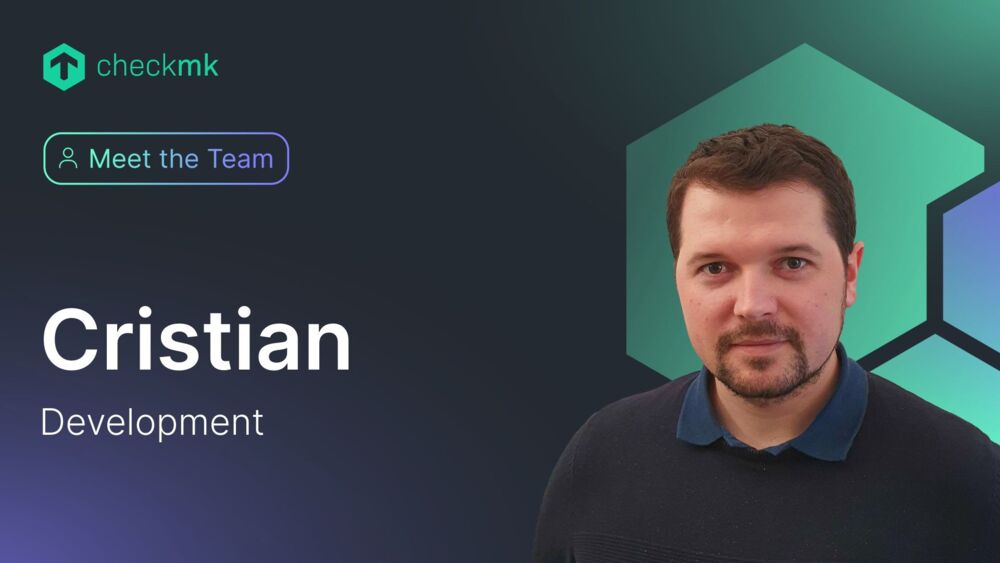
Cristian Blanaru
You have a really diverse background, starting out in IT and database administration for an international school before moving into Site Reliability Engineering and team leadership. What sparked your transition into the SRE field, and what specifically drew you to Checkmk?
The transition into the SRE field was driven by a desire to see how my architectural decisions directly impact end-users. When it’s your phone on the line, you’re incredibly motivated to be intentional with your designs, reduce friction, and build for resilience.
I joined Checkmk because it is a truly impressive piece of technology in the monitoring space. It’s the kind of software you deeply appreciate once it alerts you to five or ten limits you’re about to hit on a cloud subscription – limits you might not have had the time to set up yourself. There is no better way to ensure a tool like this reaches more people than by helping expand how they discover and interact with it.
As a Site Reliability Engineer, your main focus is ensuring systems are scalable, reliable, and highly available. What does a typical workday look like for you, and which tools are absolutely essential for your daily workflow?
My day starts by "warming up" to alerts – checking if any of my systems need to talk to me – and then shifts into enabling our developers. The goal is to ensure their changes reach production as quickly and safely as possible. If the systems are stable and the developers are unblocked, I spend my time improving existing infrastructure or building new features to increase our platform's quality.
Tool-wise, I’ll use anything that makes life easier, but I am a firm believer in "dogfooding." Nothing can monitor Checkmk better than Checkmk itself; I wouldn't even bother trying to replicate that depth of functionality in another system. For everything else, I stick to what the open-source community loves and approves of – tools that make my team’s workflow seamless.
You hold a Bachelor's in Computer Security and a Master's in Information Management. How do those academic insights – especially your background in security – influence your day-to-day decisions when building and maintaining infrastructure?
The security background sensitizes me to the continuous risks we juggle, helping me build systems that are secure by design. My Master’s, while focused on Information Management, actually leaned heavily into Entrepreneurship, which was vital for understanding the business side of engineering.
It was during those studies that I truly grasped how "assuming no risk" is, in itself, a massive risk for any organization. You have to know exactly how much risk is acceptable. These are the lenses I use daily to move fast but carefully – especially since there is always someone out there port scanning and probing for exposed ports.
Before joining Checkmk, you gained valuable experience as an SRE Team Lead. How has that leadership background shaped the way you collaborate with our development and operations teams to bridge the gap between engineering and reliability?
Luckily, Checkmk makes it easy because I’m surrounded by smart, motivated people. To me, leadership is about internal reflection – constantly improving myself so I can better serve my team.
It’s talented individuals who build brilliant products, and I want to be one of them. My leadership background helps me keep the focus where it matters: maintaining balance and fostering strong relationships with others to remove friction as quickly as possible and deliver reliably.
Balancing system reliability with rapid software development is always a delicate act in the tech industry. What is the most exciting technical challenge you face in your current role, and what is your approach to solving it?
The most exciting technical challenge? It’s hard to pick just one! We’re usually juggling at least two. Often, a challenge arises from a "we didn't know any better a year ago" situation. As the old engineering joke goes: it’s always DNS.
Originally, Checkmk Cloud used a per-client DNS record design. It made sense at the time, but it forced us into odd patterns – waiting for records to be created, adding delays here and there. When we realized we were about to employ an "anti-pattern" to fix a long-standing issue, we knew it was time for a change. We discovered the power of wildcard DNS, which simplified the entire setup and made our cloud clients much happier.
Zen was brought to DNS that day! My approach is always about curiosity. If something feels wrong or you’re fighting an anti-pattern, get curious and research. Most of the time, you’ll find an amazing solution – and if you don't, you have the chance to be the first one to build it for the community.
When you're not busy monitoring servers, managing databases, or keeping our infrastructure running smoothly, what is your favorite way to disconnect from the screens and recharge your batteries?
Hiking, cycling, SUPing, or building furniture for slanted roofs! There are so many good options; I just need more time to do them all.
What do you think makes Checkmk, or your team in particular, special?
For Checkmk, it’s how many things the software just "gets right." One rule, and suddenly my AWS account is monitored and I'm being warned about Elastic IP limits. It’s a blessing to know another engineer already solved my daily struggles.
My team is special because we are the ones bringing that experience to everyone else. A simple sign-up gives you one of the best hybrid monitoring solutions available. Being part of that journey makes us really proud.
Do you remember a particularly interesting, exciting, or beautiful experience you had at Checkmk? If so, can you tell us about it?
My best experiences are always when we solve something incredibly tricky together. Application monitoring is a great example. We had to ensure we could support all types of customers, which was particularly challenging for the Cloud edition.
Two teams came together and figured out how to make Checkmk flexible enough to handle various metrics backends while still scaling. The speed, enthusiasm, and professionalism from both sides made a very difficult task feel attainable. It’s rare to find that level of collaborative excitement.
How did you come to Checkmk? What made you decide to join?
He he heeee… should we go for the official answer? Just kidding, let’s stay real. I had learned everything I could from the startup world about managing eCommerce sites at scale, and I was looking for a project where I could bring something new and worthwhile.
It was perfect timing because Checkmk was ready to explore new strategies. After the interview, I just knew: this is it. It made perfect sense. I knew I could contribute because I’ve been through all kinds of infrastructure "hell" – I know the stakes when a heavy node acts up on Black Friday due to a caching failure. It was incredibly fortunate timing.