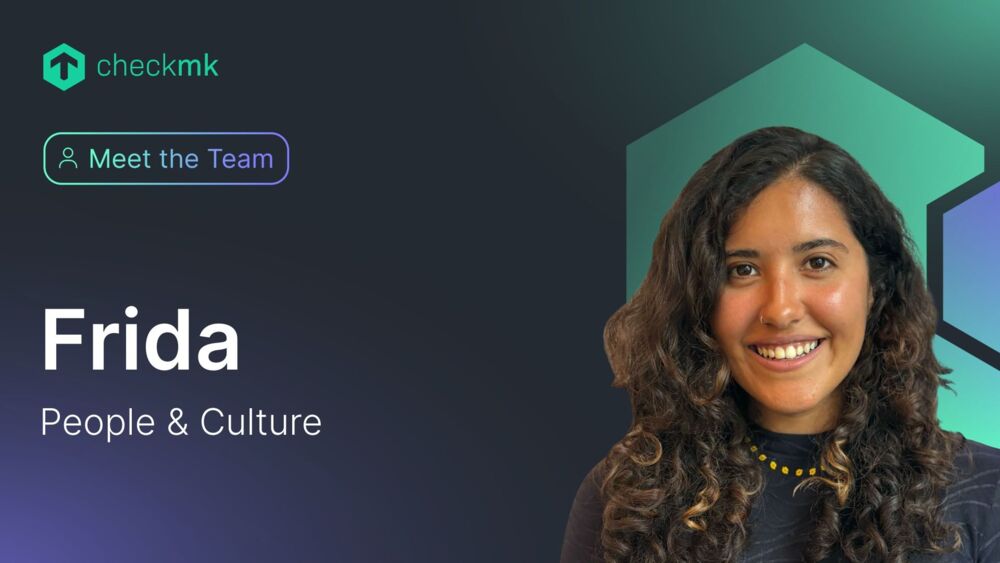
Frida Trujillo
As People & Culture Specialist and the person behind Checkmk's welcoming onboarding, you are the first person a new colleague meets on their first day. How do you design their first workday so they immediately feel like part of the team?
The first workday is all about finding a good balance between sharing important information and helping new joiners experience the Checkmk culture. That’s why we invite everyone to Munich to meet in person. We really value social connection and interaction. It’s a great opportunity for new colleagues to get to know others from their onboarding group, build connections, and feel part of the team right from the start.
The day is designed to be light, relaxed, and more than everything, welcoming. We introduce the new colleagues to key people; from their own team colleagues to our leadership; as well as to the many friendly faces they’ll meet around the office. It’s a simple way of showing who we are and how we work together.
Which phases of the onboarding process do you consider most important for achieving long-term employee retention?
Every phase is crucial in my opinion. From recruiting, and the first day, to every feedback meeting and lunch with colleagues. As in the first day, there needs to be a constant balance in the role, the tasks, the team, each interaction etc. Onboarding is a nice puzzle where all departments need to work together to make the experience great but also finely walk that two way street to make sure we are a long term match. We want to encourage but also challenge the people, empower them along the first 6 months and that “dance” is what achieves long-term employee retention, not a specific phase in my opinion.
How do you collect feedback from new hires to continuously improve the onboarding experience?
Officially, we send over an onboarding survey after ~1.5 months after start. That is a reasonable time to make sure the role and responsibilities are clearer and the person can assess their first onboarding experience. Across the 6 months of probation period there are also several feedback sessions with their respective manager. From these sources I take note and make sure to do adjustments to keep improving the onboarding experience.
Independently of the official means, my door and chat is always open for feedback 🙂
What is your approach to conceptualizing team events that work both remotely and on-site?
It is difficult as there is always the feeling that the people online can lose their engagement fast or feel left aside. Therefore, when conceptualizing events and challenges online I try to mix people in both atmospheres and encourage as much interaction as possible. I try to think what would both sides enjoy and how could people enjoy the event/ prizes/activities regardless of their location.
How important are regular company events to you in terms of the overall work atmosphere?
Especially in a remote/hybrid environment, I would say fairly regular events are important as it is a motivation for the team. It is firstly a promise that they will work hand in hand with their teams soon. Much work can be achieved more efficiently in person and being the team all together is a nice event to look forward to. Secondly, an event can work as a reset. A nice moment to enjoy your efforts, connect and simply harvest the fruits of your hard work collectively.
How do you manage to bring the core values of our culture to life during an event?
I don’t think I do. I do not explicitly bring the core values to life per se. I believe my colleagues do that on their own. So in a sense, I believe our core values are already embedded in the DNA of our events. We value positive human interactions, and we appreciate one another.
The events give us the freedom to act, to spend time with our colleagues, and above all, they create a moment where we can collaborate, work together and then enjoy that time together. They also allow us, as a company, to connect in a remote world. Simply bringing us all into the same physical space creates a sense of belonging and reinforces that we are all part of Checkmk.
What do you think makes Checkmk or your team in particular special?
I don’t think my team is “special.” What makes us feel rather lucky and unique is how open we are. We’re a group of people with interesting personalities who simply work well together. We’re open to having meaningful conversations and learning from one another; basically just humans trying our best, staying respectful, and supporting each other when needed. Maybe that is something special, or maybe it’s just a lucky coincidence 🙂
As for Checkmk, I think what makes it unique is how relaxed and approachable everyone is, regardless of their role and position in the hierarchy”. That, combined with its financial stability and benefits I would say it really stands out. I haven’t been in the workforce very long, but even so, in People & Culture I haven’t seen a team so dedicated to maintaining high employee satisfaction and ensuring things are as fair as possible.
Do you remember a particularly interesting, exciting or beautiful experience you had at Checkmk? If so, can you tell us about it?
At the risk of sounding cheesy, I have the fortune to work together with amazing people who are not only brilliant in their field but open, funny and willing to help. That makes the day to day a beautiful experience. In moments when I’ve been emotional, I had people from my team supporting me and giving me advice on how to tackle that experience with professionalism. Simply at lunch, there are always nice and interesting stories. My office buddy is all I could ask for, simply coming to the office and spending time with her, strategizing, planning makes the day to day a beautiful experience.
How did you come to Checkmk? What made you decide to join?
I wanted stability and a place where there was an office culture and a company where I could feel that work life balance is a relevant topic. Fun enough, I came across the company and their People Role in LinkedIn and saw I had a connection, so I simply asked them to give me a real perspective on how they felt. It was so positive that I did apply and every round made me feel more and more sure of my decision.