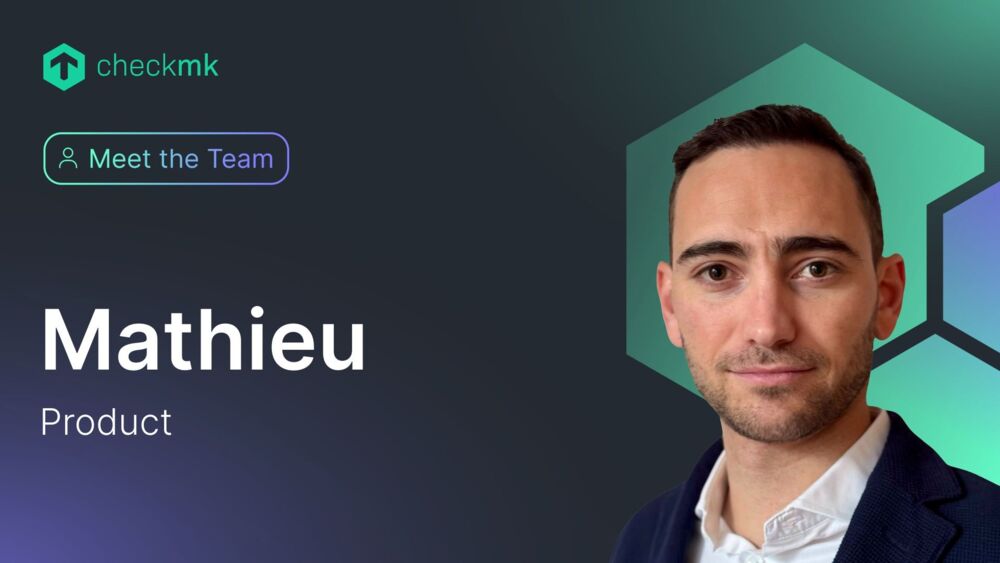
Mathieu Sobrero
You joined Checkmk in February 2025 after spending over six years at Intel in various Product Owner and Technical Product Manager roles. What inspired you to make the move to Checkmk, and what excited you most about our product vision?
After more than 6 years at Intel, I was looking for something specific: more product ownership, closer contact with users, and the freedom to make real product decisions instead of translating leadership wishes into Jira tickets. I was also looking for a more dynamic environment with faster decision-making, rather than the slower rhythm of a large corporate company.
To be honest, I didn't know Checkmk before I came across the job ad on LinkedIn, but the first lines caught my attention. It asked whether I wanted to build a product central to users' everyday lives, whether I was passionate about actually interacting with them, and whether I was looking for the freedom to make product decisions. That described almost exactly the shift I was looking for.
I then looked deeper into Checkmk and quickly felt it was a good fit. The product vision is clear, and I really like the fact that Checkmk has positioned itself around hybrid infrastructure rather than only focusing on the cloud. The idea of bringing unified visibility across the whole stack, from on-premise to cloud, and the focus on helping users in their day-to-day is what convinced me to take on this challenge. More than a year on, I am glad I made this move.
You have an engineering degree in Electronics and Telecommunications and a strong technical background in firmware and software infrastructure. How does this deep technical foundation help you as a Product Manager when collaborating with our development teams?
My technical background doesn't make me a better PM, but it does help in how I work with the development team. Checkmk is a technical product and our development teams are highly technical as well, so a solid technical foundation is definitely helpful here.
The main benefit is that we speak the same language. When the team is discussing architecture, trade-offs, or the refinement of a feature, I can follow the conversation, ask questions, and contribute meaningfully rather than just taking notes. It also helps me understand the reasoning behind technical decisions, even when they aren't the most convenient from a product perspective, so I can represent them clearly to stakeholders.
You’ve been heavily involved in the Checkmk 2.5 release, specifically transforming the dashboarding experience. Can you tell us a bit about that project – what were the main challenges, and what new capability are you most proud of delivering to our users?
The dashboarding project was one of the big topics of the 2.5 release, and it was a significant transformation. Dashboards in Checkmk had always been powerful, but creating and customising them wasn't intuitive, especially for new users. The goal was to make the experience much easier from creation to daily use, without taking away the flexibility that more advanced users rely on.
The main challenges were on several fronts. First, defining the right scope was difficult. Dashboards touch a lot of areas in the product, and we had to draw a clear line between what would land in 2.5 and what would come later. Second, balancing the needs of power users and newcomers required real trade-offs, as every simplification carried the risk of removing something an experienced user depended on. And on a personal note, this was also my first project at Checkmk, with a new development team, on a complex topic, so part of the work was simply building the right way of working together: how we refine, how we make decisions, how we validate ideas.
What I am most proud of is actually the collaboration itself. The improvements we delivered came out of a real joint effort between Product, UX, and Development. Thanks to that close cooperation, we managed to build workflows that are more intuitive for both new and advanced users, from dashboard creation, to widget configuration with the new live preview, all the way to analysing data through a unified dashboard experience. Bringing all of that together as a team, and seeing it land as a real improvement for our users is what makes me proud.
In your previous roles, you've managed product backlogs and priorities for large scrum teams. How do you approach prioritizing features and balancing immediate customer needs with the long-term technical roadmap here at Checkmk?
To balance immediate customer needs with the long-term roadmap, we follow a clear split at Checkmk. On average, 60% to 70% of our capacity goes to roadmap initiatives, while 30% to 40% is dedicated to bug fixes, small improvements, and support tickets. This way, urgent customer pain is addressed without losing focus on the longer-term direction. That said, when trade-offs are necessary, I stay transparent with stakeholders about why something is prioritised or postponed, and push back constructively when needed.
Recently, you invited the Checkmk Community to a 'bug bash' session to test the new dashboards before release. How important is direct user feedback to your product development process, and how do you integrate those insights into the final product?
User feedback is an essential piece of our product development process, as we are building our product for our users.
The bug bash on the new dashboards was a good example: we invited the community to test the experience before release, to catch bugs early, validate usability assumptions, and get honest reactions to the UX changes. The feedback is then triaged with the development and UX teams, usually using a value versus effort assessment to decide what is worth tackling and when. We try to address quick wins before the release, while larger items go into our backlog and are picked up based on prioritisation and strategic alignment with our product vision. Not everything ends up in the product, but every piece of feedback is considered.
When you're not planning roadmaps, aligning with stakeholders, or presenting new features at the Checkmk Conference – how do you like to spend your free time in Gdańsk to relax and recharge?
In my free time, I love spending time with friends and family around good food. I am also a big fan of sport, I run quite a lot with a trail running group, and last year I bought a gravel bike to explore the Tricity forest a bit further. I am also still playing football in a local league, though this will most likely be my last season.
What do you think makes Checkmk or your team in particular special?
What makes Checkmk special to me is the combination of real product ownership and the trust that comes with it. Decisions are made quickly, there is very little politics, and you truly feel that your input matters.
The culture is honestly amazing. The company is truly product-led, and the way people work together is something I value a lot. Everyone I meet is open-minded, passionate about building an impactful product for our users, and collaborative, whatever the team or the role. There is also a strong feedback culture, people speak openly, share their views directly without fear of being judged.
Do you remember a particularly interesting, exciting or beautiful experience you had at Checkmk? If so, can you tell us about it?
One experience that really stands out is my first Checkmk Partner Day. I had the chance to go on stage and present the new dashboards to partners who use Checkmk every day, and it was a special moment for me. It was my first time presenting in front of such a large audience, and also the first time we could share the full story after months of work, directly with the people it was made for. Seeing their reactions in the room, and chatting with them afterwards, made all the work feel very real.
What made you decide to join Checkmk? How did you come to Checkmk?
What really convinced me to join Checkmk was the hiring process itself. There was a technical challenge in the second round that gave me a concrete sense of what the work would actually look like, and it helped me project myself into the product role and the company before signing. The conversations along the way confirmed the rest, they were open, direct, friendly, and with a clear user-centric approach.