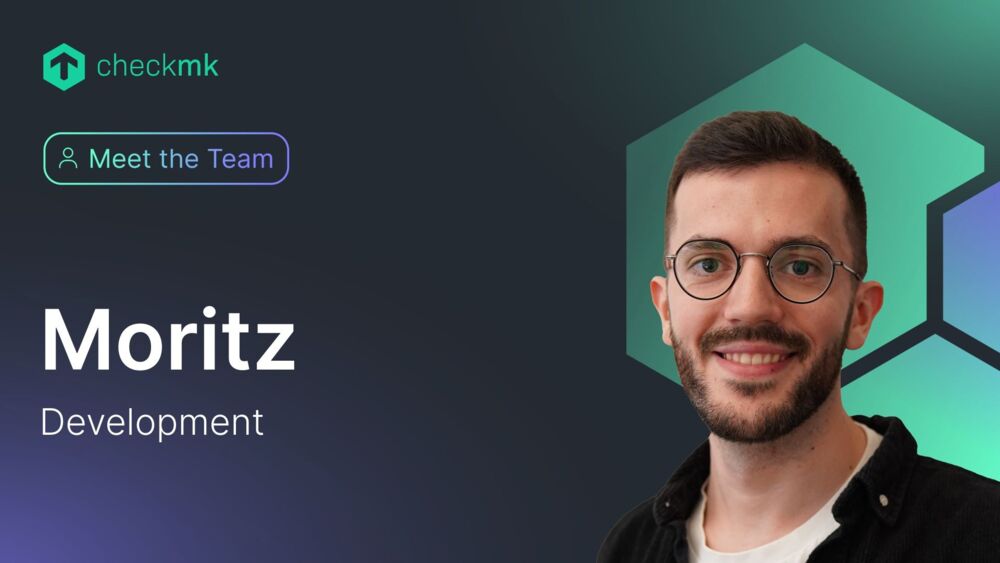
Moritz Kirschner
You've been with us since February 2024 and were promoted from Software Developer to Team Lead at the beginning of 2026. First of all, congratulations! How did you experience this transition and what is the biggest change in your daily work routine?
The transition felt very natural. Everything was well prepared and I was already able to gain experience as an Interim Team Lead for a few months. For the actual change, I then attended a training course in parallel. I am very satisfied and really enjoy the new role in this team! The biggest change is definitely the perspective: you look at problems from a new angle and develop a sharper eye for potential hurdles in the future.
You did both your Bachelor's and Master's in Physics at the University of Heidelberg, but dove deep into software development. How does the analytical and problem-solving mindset from physics help you today when programming and leading a tech team?
My studies constantly forced me to familiarize myself with a wide variety of topics in a very short time. I will probably benefit from this experience for the rest of my life. I'm not afraid of not understanding things at first, because I know what to look out for in order to quickly get up to a good working pace.
A few years ago, you worked as a lecturer and introduced students to computer science. Do you still use these didactic skills today, for example when it comes to mentoring your own team or explaining complex technical issues?
My biggest takeaway from my time as a lecturer is that you should always keep an eye on whether someone feels left behind in a discussion. In the end, everyone has valuable input to offer. You have to create a space where everyone feels comfortable contributing as soon as they want to.
With a strong background in Python, TypeScript, and C++, you bring a lot of technical expertise to the table. In your new position as Team Lead, how do you manage to balance your own coding with the strategic and organizational leadership tasks?
The amount of active coding in my everyday life has certainly decreased a bit since I took on the new role. Nevertheless, I still take on some of the technical tasks in the team. Besides, we always try to leave room for intrinsically motivated projects, which I enjoy a lot. I will probably never completely let go of the keyboard.
What exciting technical challenges are currently coming up for you and your team at Checkmk, and what do you value most when it comes to the architecture and quality of your software?
There is still a lot of DNA in our team from our time as a platform team. We continue to attach great importance to providing the right tools for all UI teams, and are working intensively this year to reduce technical debt in this area. For me, interfaces are the be-all and end-all in software development. No matter if big or small, for customers or internal tools: every system has to communicate clearly what is happening. That is the only way a big whole can emerge from many small parts without ending up in complex spaghetti code.
When you close your laptop after an intensive day full of code reviews, architecture meetings, and team syncs – how do you prefer to clear your head and switch off from everyday IT life?
My head usually really clears up at the swimming pool when I'm doing my laps to switch off completely. But to be honest: in my free time, my favorite thing to do is continue developing my own video game engine :)
How did your journey at Checkmk begin? What made you decide to start at Checkmk?
I became aware of Checkmk quite unspectacularly via LinkedIn. But I was then very quickly convinced by the product, the remote work concept, and the open-source culture.
What makes Checkmk – or your team in particular – special?
Our team is a colorful mix where every single person brings in a valuable perspective. From practical to detail-oriented, from user- to implementation-focused: I believe there are few projects that you couldn't throw at us. I really enjoy this versatility.