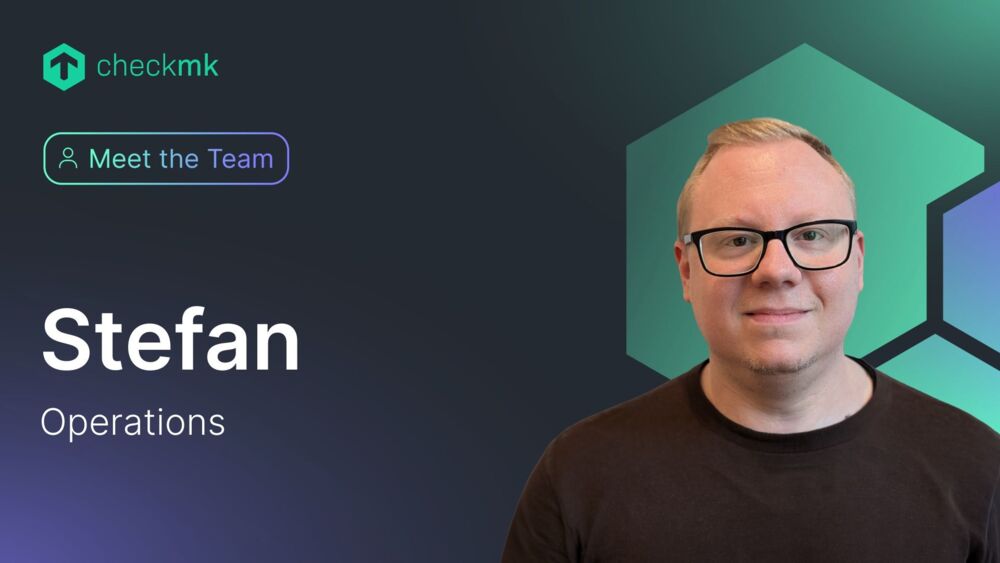
Stefan Ziegler
Your team is responsible for the ERP system landscape. How do you proceed when you want to automate business processes (such as invoicing or CRM workflows) or extend them with custom modules?
We take on various roles here. First of all, it's about gathering and understanding requirements. Often, this also means understanding the department's intention behind it and establishing context. We don't simply implement every order without asking questions; instead, we always work to deliver the added value behind the request. Sometimes this can mean sitting down with the department and reshaping the request together. Once this hurdle is overcome, the request is in our backlog and assigned to one of our Product Owners. For implementation, we plan, develop, and deliver these developments or changes based on agile methodologies.
How do you ensure the security, availability, and performance of our Customer Portal, especially when introducing new features or updates?
Our tool landscape covers many different styles of applications. From internally self-hosted custom solutions to in-house developments in the cloud, to fully purchased SaaS tools. As the developer of an IT monitoring platform, we are our own customers here and use Checkmk wherever possible to monitor our own servers and cloud solutions and alert our teams where necessary. As far as continuous development goes, we've taken a typical path for a rapidly growing company: documentation and manual testing are being successively replaced by more robust, partially, and ultimately fully automated QA processes. Starting from standard semantic checks on merge requests all the way to an automated E2E test suite in an emulated browser.
What are the most important steps for you to optimally adapt Jira workflows and permissions for different teams without making the system unnecessarily complex?
Speaking from the perspective of the Operations team, I try to keep complexity as low as possible when it comes to ticketing for project management. Basically, it's important to us to create transparency regarding the current status through our tickets and to ensure that no change remains undocumented. We follow two simple basic rules: "no commit without a ticket key, no ticket without a parent." As for workflows specifically for team organization: we continuously combine long-term initiatives with short-term changes in sprint planning, which we manage out of two separate Jira projects. All other teams in the company that rely on Jira workflows for their own management have autonomy here. As the Operations team, we don't impose any guidelines.
In the Operations team, you are the technical interface for many different departments. How do you prioritize your tasks when several teams simultaneously demand urgent adjustments to systems?
It's a continuous trade-off. We even reflect this fact through our formal team organization at the ticket level. On the one hand, we are represented in almost all company-wide initiatives, naturally to varying degrees depending on the case. Here, it's about shaping this longer-term vision into quarterly planning that we adopt for ourselves. Of course, nobody can see into the future down to the last detail, and we have to be able to react to short-term changes – even unexpected ones. Wherever possible, we manage this with pragmatic flexibility and good coordination. If an unexpected situation gets so big that it significantly impacts team capacity, we sit down with our stakeholders and address it to re-prioritize together.
What drives you to continuously question and optimize existing internal systems and workflows?
I always say I want to create a productive environment that is also fun. Of course, pursuing our shared goals comes first, but both systems and workflows – whether lived inside or outside these systems—are just tools to achieve those goals. As such, their position and purpose are clear. If the tool doesn't serve its purpose, if it gets dull, it usually quickly creates noticeable friction or extra effort. That gets noticed fast and takes the fun out of it. I don't like sitting at my workstation with the tool preventing me from reaching my goal, so I really don't want to expect that from my colleagues either.
How do you establish feedback loops with internal users or customers to ensure that system updates actually improve usability and satisfaction?
Listening! For all key systems where friction exists, it will stand out. Through our sprint-based delivery, we've managed to build an internal reputation for truly developing continuously and reliably. That's why all kinds of reports and suggestions reach us immediately and without judgment. All we have to do is listen and take them in. As a small footnote: if it's about changes we're driving ourselves or building blocks in the system landscape that users rarely run into, we have to listen a bit more actively and ensure we get our feedback to bring things to a close. ;-)
How did your journey at Checkmk begin? What prompted you to join Checkmk?
When Checkmk reached out to me, I was thrilled by the authenticity and openness throughout the process. During the application process, we worked on a problem together – through the clear answers and genuine participation of my counterparts in the conversation, it quickly became clear that this wasn't just some generic example trying to abstractly draw conclusions about my skills or working style, but a scenario that exists either as-is or nearly identical in everyday work, and working on it would look exactly like that, at eye level. On the one hand, I liked this approach and the trust behind it; on the other hand, it was simply a great fit personally and content-wise on both sides. Everything that came after only confirmed the impression from that day and the decision.
What makes Checkmk – or specifically your team – special?
The openness and attitude I experience at Checkmk creates an environment where everyone is interested in moving forward and understands that it works neither alone nor against each other. That means everyone also has a genuine interest in helping others succeed. At Checkmk, you can pull anyone aside, confront them with a question, and be sure you'll leave the conversation with a new, valuable perspective. I really appreciate that.