User experience monitoring for any application
Stop waiting for tickets to find out if your services are down. Monitor critical user journeys end-to-end and catch breakages or slowdowns before they impact your customers.

Trusted by industry leaders worldwide










Synthetic monitoring, built for operations
Run tests continuously across your environment. Handle results, alerts, and context in one platform.
One platform to monitor any application
Test web apps, desktop apps, and APIs with one framework and reusable keyword libraries.
Full visibility natively within Checkmk
Every test becomes a Checkmk service. Alert on failures and runtimes, then investigate with the relevant infrastructure context.
Predictable costs, simple licensing
Pay per test — not per execution interval or per transaction. Increase frequency without cost surprises.
Catch user-facing issues before they hit the helpdesk
Stay ahead of user-facing issues in critical journeys — even when infrastructure metrics look healthy.
- Cover critical workflows: Validate logins, checkouts, and form submissions.
- Objective service KPIs: Track availability, function, and runtime with clear thresholds.
- Location-aware verification: Confirm behavior across regions, branches, and remote offices.
- Dependency assurance: Monitor third-party services such as payments and identity providers.
Monitor metrics that matter
Run automated transactions that mirror real user journeys. Get clear signals for availability, functionality, and runtime.
- Availability: The entry point responds and the journey starts.
- Functionality: The workflow completes and returns the expected result.
- Runtime: Step and journey duration stay within defined thresholds.
Transaction patterns
- Session and navigation flows.
- Checkout and payment journeys.
- SSO authentication and role-based access.
- REST API transaction with response validation.
- Windows desktop workflows.
- Backend validation steps within a journey.

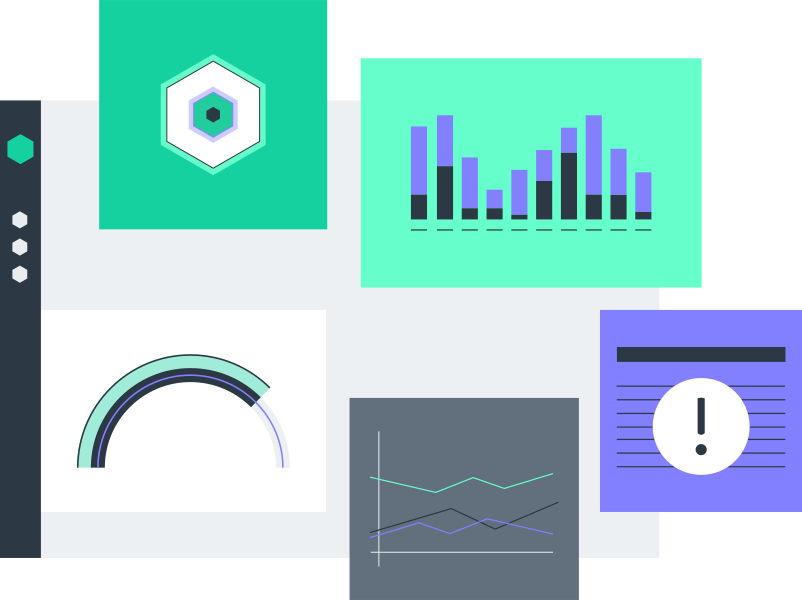
Link user experience to infrastructure context
See synthetic test results next to your infrastructure signals — and move faster from user impact to root cause.
- Unified views: Show tests alongside hosts, services, and clusters.
- Faster triage: Link failed user journeys to infrastructure signals and recent changes.
- One alerting model: Apply the same rules and notifications across synthetic and infrastructure monitoring.
Automated execution — from test script to Checkmk service
Turn tests into operational insights. Run them on schedule. Alert on failures and threshold breaches.
- Test scope: Model a full journey or a focused critical step.
- Keyword KPIs: Add up to five KPIs per test to pinpoint the failing step.
- Runtime thresholds: Alert when step or journey duration exceeds defined limits.
Operational capabilities
- Scheduled execution: Run tests at defined intervals.
- Automatic reruns: Re-execute failures to confirm persistent issues (optional).
- Actionable evidence: Use logs with screenshots/recordings to speed up diagnosis.
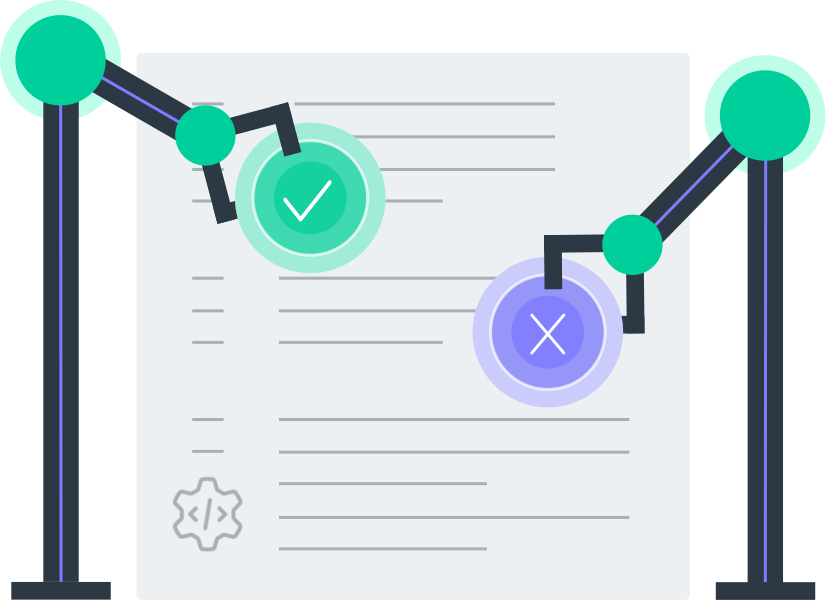

Run tests where your users are — on your own infrastructure
Place test nodes in the regions and networks you operate. Keep execution and monitoring data under your control.
- Distributed execution: Run tests from Linux or Windows nodes across sites and regions.
- Central lifecycle management: Deploy and update test runners and configurations centrally.
- Lean footprint: Extend coverage without adding a separate monitoring stack.
What is Robot Framework — and why it matters
Robot Framework is the open-source standard for keyword-based end-to-end test automation. Robotmk runs Robot Framework tests and integrates the results into Checkmk. Together, they form Checkmk Synthetic Monitoring. You write tests in Robot Framework, run them via Robotmk on your nodes, and monitor every test as a Checkmk service.
- Readable test design: Keyword-based tests stay maintainable.
- Reusable libraries: Apply the same approach across web, desktop, and API workflows.
- Extensible keywords: Add Python-based keywords for specialized scenarios.
- Portable assets: Keep full ownership of tests outside proprietary scripting.
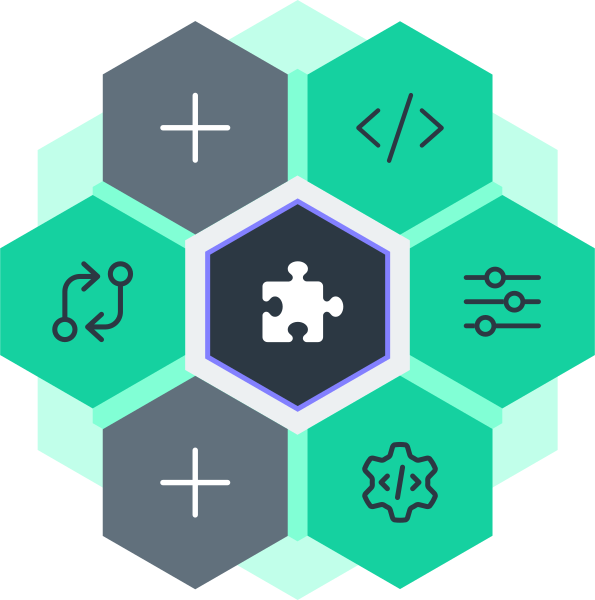

Why teams choose Checkmk for synthetic monitoring
A synthetic monitoring approach for enterprise operations: broad coverage, monitoring-native execution, and predictable licensing.
- Coverage across technologies: Web, desktop, API, and backend validation under one approach.
- Monitoring-native integration: Services, dashboards, rules, and alerting inside Checkmk.
- Enterprise control: Self-hosted execution with full data sovereignty.
- Predictable licensing: Pay per test — independent of execution frequency and transaction length.
- Extensible by design: Reusable libraries plus Python for specialized scenarios.
- Proven foundation: Built on Robot Framework as the underlying automation standard.
Customer stories
See how teams run Checkmk in production, from a few hundred hosts to hundreds of thousands of devices.
Watch short customer videos or read the full case studies to see what these teams monitor, the problems they hit along the way, and how they solved them with Checkmk.


Editions for different enterprise needs
Checkmk Synthetic Monitoring is available in multiple editions to support different infrastructure sizes, operational requirements, and levels of complexity — from initial adoption to large-scale hybrid enterprise environments.

How LGB cut downtime on Brandenburg's critical geodata services by over 90%
The strength of Synthetic Monitoring is showing whether the whole system genuinely works together. The whole band has to play — no single musician can drop out
Ready to get hands-on with Checkmk Synthetic Monitoring?
See tests, alerts, and runtime thresholds in action.