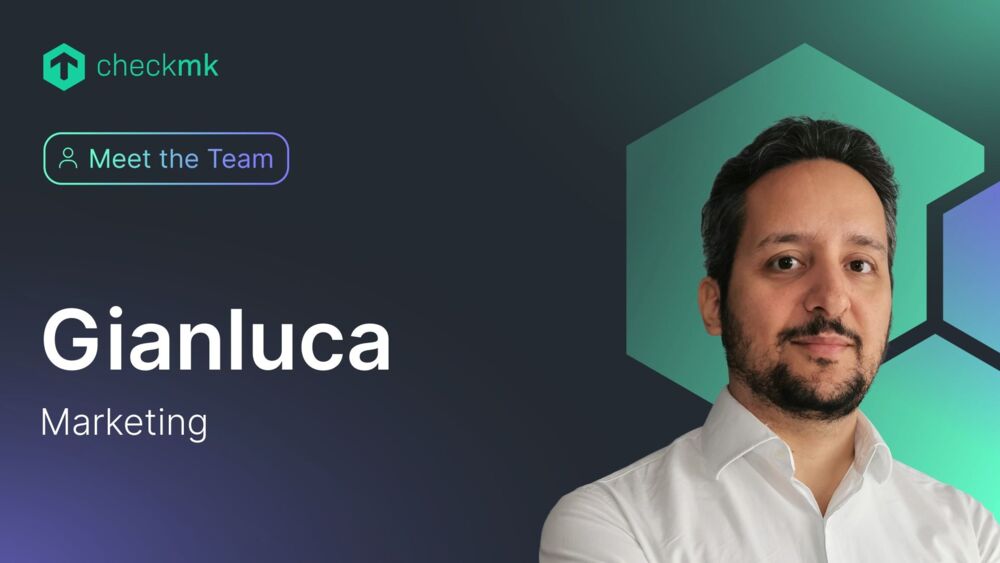
Gianluca Fiore
Hi Gianluca, thank you very much for taking the time for the interview!
How did you come to Checkmk?
I was two years into a career change, from development/system administration to content writing. While happy with the switch, I was at the point where I didn't feel challenged in my role as a technical writer, and was up for a more dynamic setting. The marketing team was in need of a content writer with a technical background, which fit my aspirations. I felt extremely welcome throughout the interview process with Checkmk, as never before. It was also a tight and relatively quick process, which only increased my feeling that joining Checkmk would be the right choice. So far nothing has contradicted that feeling, quite the opposite to be frank!
What is your job at Checkmk?
I write technical content for the Checkmk website. Mostly of the educational type but with a marketing twist. These may be anything from blog posts, in-depth guides, technical articles, and whole page’s content. Along with that, keyword research, content planning, building the pages on the CMS, preparing marketing brochures and the occasional translation of English content to Italian are the other tasks I have been tackling at Checkmk so far.
What does your working day look like?
I tend to start the day at around 9 in the morning. The first half hour of the day is usually about catching up with emails, checking the new workday’s tasks, and syncing with Slack messages. I either research, write, or proofread content every day. Depending on the type of content I may need to ask around or have a meeting with experts. Usually, I write a lot in the morning, and spend the other half of the day researching, thinking, and completing the less exciting tasks that make part of any job.
What tools/tech stack do you work with?
Daily we communicate through Slack and Zoom. These are the staples. For writing, I always wanted to learn VSCode and started using it at Checkmk. I write everything there first, before exporting to GDocs for reviewing and getting feedback from colleagues. Jira helps everybody to stay organized and to achieve the necessary results. GIMP I find invaluable in helping with doing graphical tasks, like converting or editing screenshots. GDocs are useful for editing and creating presentations or brochures. At the moment, nothing else is necessary.
We are of course particularly interested in what working remotely from Poland looks like. Can you tell us a little bit about that?
I had been working remotely for two and half years before joining Checkmk, so I was thoroughly familiar with it. The government left complete freedom to companies to set up remote work from the first weeks of the COVID19 pandemic, and that has encouraged more employees to learn to live without any physical contact with colleagues and managers. Most workers here are enthusiastic about the remote style of working, internet speed is decent and its costs low, and all the companies I know reimburse equipment expenses to work from home. The switch was really seamless for me.
Culturally most Poles are not of the social type, so there is not really any push from below to come back to the office anytime soon. The vast majority of companies are keeping either a 1-2 days per week at the office or a 100% remote stance. There’s definitely a small trend of younger millennials moving back to their parents’ houses in the countryside and working remotely, cutting rent and commuting expenses.
How do you see the difference between working remotely abroad and working locally? Are there advantages or disadvantages on the respective sides?
This question needs a book to be answered! Having worked both from the office and remotely for years now, I would say that the biggest disadvantages of remote working are a more difficult onboarding and a prolonged period where you don’t really know whom to ask around when in need. In an office you can always look around and understand who knows more or who is a manager of what team. Remotely this is not possible. A single point of contact for everything at the beginning is vital to assuage both disadvantages. Working remotely it is clearly harder to network too, and depending on where you are in your career this can be a big issue.
On the other hand, working remotely has a longer list of advantages than locally: it is easier to focus, there are fewer distractions, breaks can be real ones and not just hanging around the coffee machine talking about work with colleagues, and the flexibility in how to organize your day in and out of work is unparalleled. There is less time that feels like “padding” between work, and both more productive and break time. I wouldn’t switch back to working locally unless there was an unquestionable work-related need.
How do you think content writing, in marketing or elsewhere, will evolve in an AI-powered world?
I have been integrating AI into my job here and there, mostly in the last year. I find that it can do the rough initial work or get the writing started well but requires much polishing to sound natural and to correct the frequent hallucinations. Ideally, I would say that AI is a great companion for writing, planning and, especially, researching content.
But I would also be naive in not considering the possibility that many companies would cheap out and take the “100% of the content AI-generated” way. I see content writing continuing as a job, flanked with AI tools, but most of the simplest, entry-level jobs will not be human-based anymore.
Explore open positions at Checkmk
We count on smart and innovative people who can help our customers become more secure and resilient.