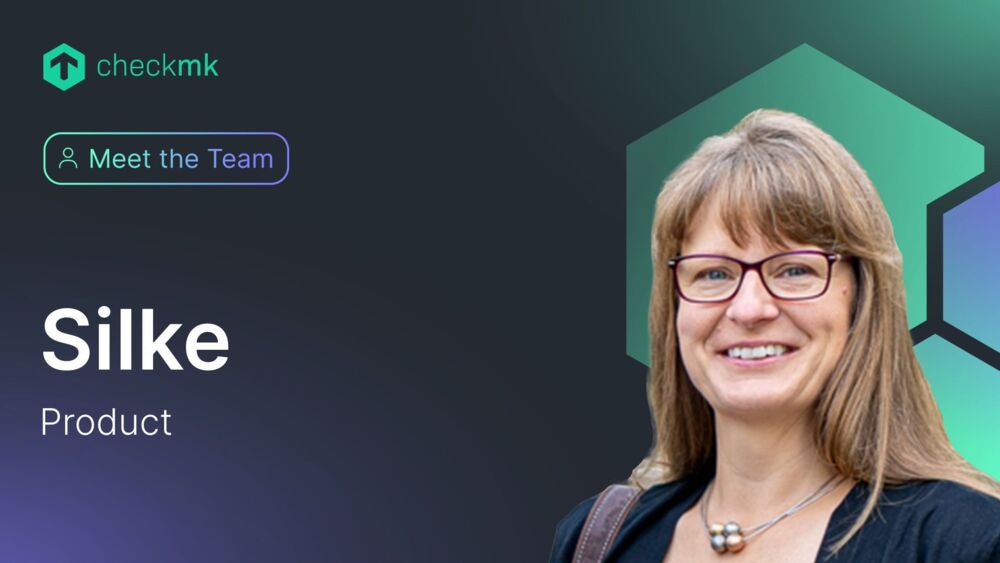
Silke Paintner
Hi Silke, thank you for your time! You have been a member of our Knowledge Team since November 2021 as a technical writer, primarily responsible for the Checkmk handbook.
What made you decide to join Checkmk?
After ten years in my previous job, I felt stuck and like I was just going in circles. I wanted a new challenge and the opportunity to grow. The Checkmk homepage and the handbook immediately appealed to me. The tone was relaxed, dynamic, and modern – and that’s exactly how I experienced the people I met during the interviews.
Having previously worked exclusively with Windows, you’re now using Linux. How was the transition for you?
The first few weeks were challenging. Linux works very differently from Windows in some areas. In my second week, I was sent to a Checkmk training course where I suddenly had to enter commands in the terminal. That was tough. The Linux basics online course that followed helped me a lot. But above all, my colleagues supported me from the very beginning and patiently answered all my questions – and that hasn’t changed to this day.
What fascinates you most about your work at Checkmk, and what are your tasks?
I describe the many features and capabilities of Checkmk in the handbook – as clearly and comprehensibly as possible. The texts should be suitable for every version, every edition, and every reader. That’s the main appeal of working on the handbook for me. Expressing things in an elitist and incomprehensible way isn’t difficult. The real challenge is to explain highly complex concepts so that as many people as possible can understand and apply them in their own work environments.
Since we work with a four-eyes principle, I also regularly proofread my colleagues' texts and check them for clarity, completeness, and accuracy. Additionally, I contribute to improving and translating the texts within the Checkmk user interface.
What does a typical work week look like for you?
I work part-time and usually start around 8 a.m. I check what’s new and see what’s on the agenda. Then I write a new article, revise a section of the handbook, or proofread a colleague’s text. We have a short daily status meeting that breaks up my morning, so I usually work on two different topics before and after that – it clears my mind and shifts my perspective.
Since some team members work only in the afternoons, I work two full days a week, usually from the office. That’s when we have additional meetings and the weekly team-wide check-in.
What tools/technologies do you use in your team?
Our daily communication happens mostly via Slack. For writing, we use Visual Studio Code and Git. I still think Gimp is a great tool for creating screenshots. Since we’re not all in the same place, meetings are held via Zoom. We use Jira to plan and assign our various tasks. And finally, I work with Weblate to review, correct, and translate the texts in the Checkmk user interface.
Describe in your own words the relationship between Checkmk and its customers. What makes this relationship special?
In my area of responsibility, I don’t have direct contact with customers. So far, I’ve mostly met them at the Checkmk Conference – but I liked the atmosphere right away. Everyone is open and friendly, and the general use of “Du” (first-name basis) enhances the feeling of one big community.
What makes Checkmk so special?
How can I describe it? Checkmk is so fundamentally different from the companies I’ve worked at before….
How can I put this… Checkmk is fundamentally different from the companies I’ve worked for before. Here, “team” doesn’t mean “Toll, Ein Anderer Machts” (Great, Someone Else Will Do It) – it really means that people tackle things together. The way we interact is relaxed and familiar, yet productive. Everyone treats each other as equals – from working students to executive leadership. With regular team events, both in smaller groups and company-wide, everyone is valued, included from the start, and continuously motivated.
Explore open positions at Checkmk
We count on smart and innovative people who can help our customers become more secure and resilient.