Checkmk monitors retail environments at Edeka
Challenge
- Monitor retail IT across a large footprint with edge monitoring that keeps working even when store connectivity is unstable or interrupted.
- Replace a heavily customized Nagios landscape where 1,200 independent Nagios servers had become a scalability and performance bottleneck.
- Centralize visibility and automation: auto-discovery of new systems, easy on-site views for non-IT staff, and business-relevant alerts (e.g., checkout readiness thresholds).
Why Checkmk?
- Designed for scalable distributed monitoring: local sites in stores with central aggregation for enterprise-wide oversight.
- Fast rollout and low operational overhead through agent-based monitoring with minimal configuration and automatic inventory.
- Strong rules, BI aggregation, and visualization: global thresholds via rule sets, central status evaluation with Checkmk BI, and geo-based monitoring views (NagVis geomap).
Results
- Successfully standardized on Checkmk in 2012 with 1,200 monitoring systems across store IT, centrally consolidated and evaluated.
- Monitoring at scale: ~25 hosts and 250 services per server on average — about 300,000 services checked every minute.
- Reduced effort for ongoing operations through global rules (26 rules) and automated discovery.
About Edeka Minden-Hannover
-
Industry
Retail
-
Headquarters
Region Minden-Hannover
-
Employees
32,000
-
Monitored hosts/services
300,000
-
Solution
Checkmk Pro
Challenge
Edge monitoring for retail environments
Edeka Minden-Hannover was looking for a cost-efficient, flexible and modern solution to monitor its stores and central IT systems. The organization originally selected the Nagios open source software. The IT team installed Nagios manually and extended it bit by bit with add-ons such as NSCA or NagVis. However, the performance of Nagios soon reached its limits.
A first problem was the heavy network load due to the many details the monitoring has to cover. Also, even with graphical configuration tools such as NConf, the workload for the IT team just for managing the monitoring environment became unbearable. In time, the Nagios server also turned out to be a performance bottleneck. Thus, the IT team had to start looking for a Nagios alternative.
They found Checkmk. Edeka Minden-Hannover was able to replace its Nagios environment easily. Thanks to Checkmk, the IT team can continue using existing Nagios plug-ins after some minor adjustments. Because Checkmk runs on any major Linux distribution, Edeka Minden-Hannover was also able to install Checkmk on its existing SUSE Linux Enterprise server infrastructure.
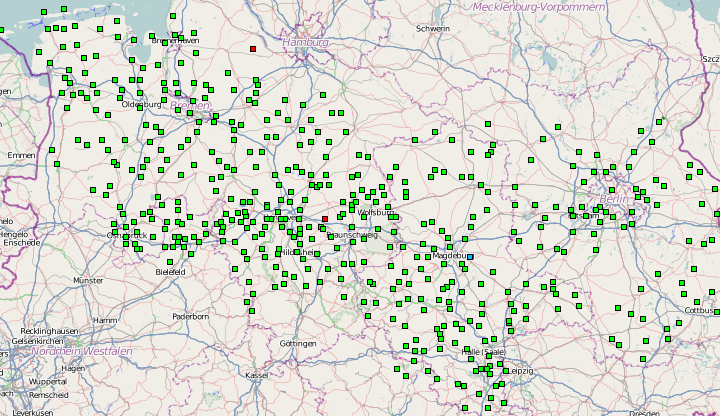
Edeka Minden-Hannover’s monitoring requirements are demanding: The IT team wants to gather the monitoring data at a central site to be able to gain an overview of all their IT environments. The monitoring should automatically generate a map, based on GPS coordinates, as a central status monitor. In critical situations, it is also important to send automatic notifications, for example, if fewer than a specified percentage of cash registers are ready to operate in a store.
Solution
Reliable store monitoring with centralized visibility
In most markets, there are no IT specialists available, so another requirement is that employees without IT experience should also be able to understand and use on-site monitoring. At the same time, the monitoring should automatically add new systems into the monitoring. In addition, monitoring in the stores must also continue to work, even if a store is disconnected from the rest of the network or the connection is unstable. The only way to ensure this is to monitor local systems through a local monitoring site.
At the same time, Edeka Minden-Hannover wants the monitoring to aggregate data centrally. Checkmk brings its own agents that do not need to be configured on the monitored systems. This made the roll-out very easy, even with a large number of systems. Thanks to its inventory function, Checkmk automatically detects which aspects of a system can be monitored. Checkmk regularly scans the local network of the respective store for new components. To do this, the IT team relies on the standard nmap tool. As soon as nmap finds a new system, Checkmk uses the automatic inventory function to determine which of the systems’ services need to be monitored.
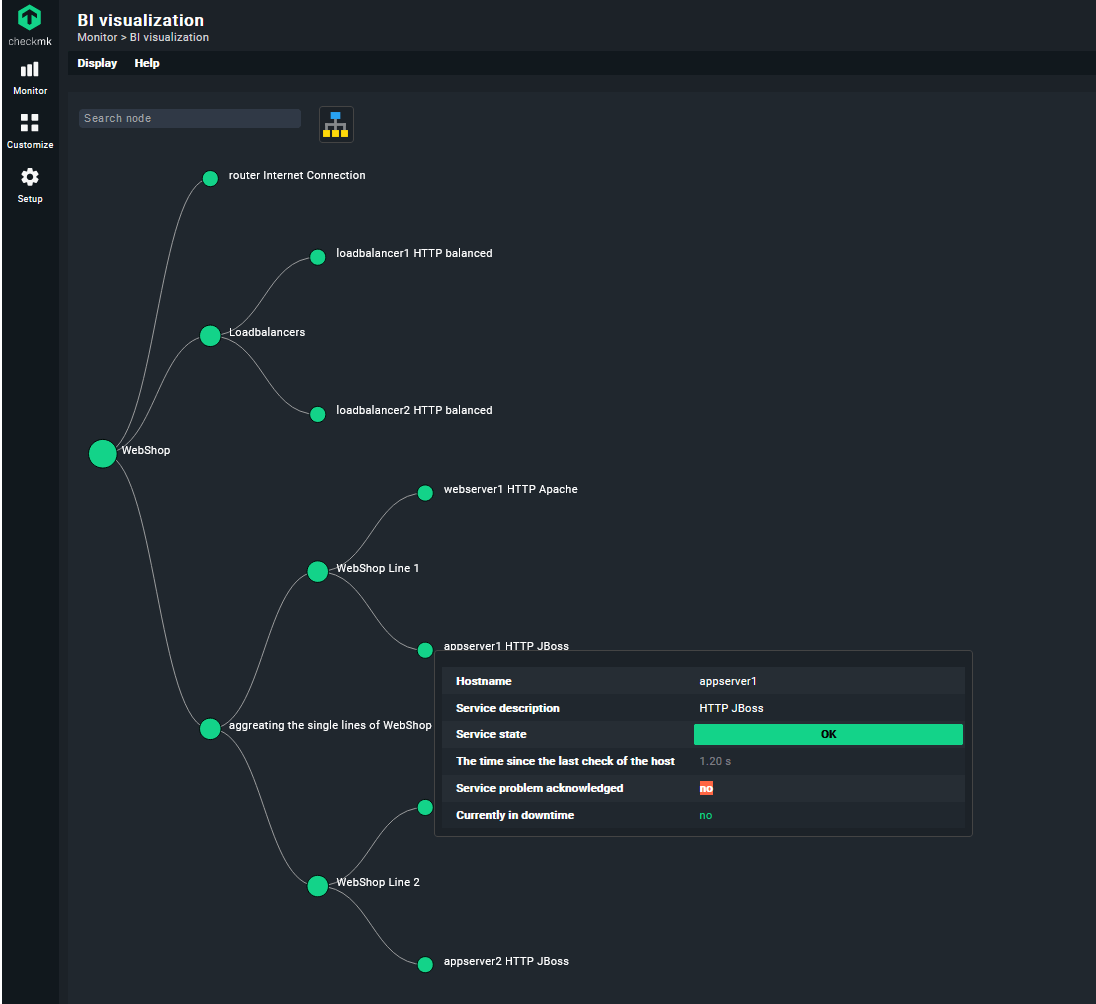
The IT team configures the threshold values via flexible rules on the central monitoring site and applies the monitoring rules globally across all stores. Checkmk thus minimizes the effort required to manage the monitoring in the stores. The rule set consists of 26 different rules. The aggregated overall status from each market can then be evaluated in the central Checkmk site. This aggregation is realized with the help of the Checkmk Business Intelligence (BI).
Checkmk uses its JSON-based web service for the implementation. This ensures that the information in the central site is up to date and reflects the current state of the store IT. A dashboard based on the data from the central site displays the overall status on two 55-inch monitors. On this dashboard, there are individual views (dashlets) that show, among other things, the stores with connection problems and host or service problems in their own lists. As part of the project, NagVis was extended to include geomap functionality. NagVis creates a map using the GPS coordinates of all locations and freely available map material from OpenStreetMap and positions the locations on this map.
Results
Faster rollout and scalable operations
During the initial installation of Checkmk, the Checkmk team also developed some new Checkmk checks (such as the monitoring of Bintec routers), which were subsequently incorporated into the official version of Checkmk. Following a few weeks of planning, Edeka Minden-Hannover and Checkmk carried out this major rollout to all stores in a four-day on-site process.
Within six hours, Edeka Minden-Hannover had installed a total of 1,200 monitoring systems. That means three new systems per minute! Following the installation, Edeka Minden-Hannover connected all of the systems in the stores to the central site. At the same time, the IT team put the geomap with the information from the stores into operation.
With little effort, and in partnership, Edeka Minden-Hannover and Checkmk developed and successfully implemented a suitable monitoring solution. The entire project was developed based on license-free software. At the same time, Checkmk provided expertise and further expanded the customer's monitoring know-how.
-
Massive-scale monitoring consolidation
-
Rapid, high-velocity system rollout
-
High-frequency enterprise service checks
-
Resilient, offline-capable retail monitoring
-
Automated, rule-based operational efficiency
The speed and target achievement, all the way from planning to implementation, surprised us. The collaboration with Checkmk was professional and determined from the very beginning.
About the customer
Edeka Minden-Hannover is the largest of Edeka’s seven regional cooperatives in Germany, operating around 1,600 stores and employing 32,000 people (2020). Covering a wide territory across Northern Germany, the organization depends on reliable store IT and centralized oversight to keep retail operations running smoothly. Since 2012, Edeka Minden-Hannover has used Checkmk’s scalable distributed monitoring to combine local resilience in stores with centralized transparency across its retail environment.