Checkmk as an alternative to Nagios
Checkmk is the full-stack monitoring and observability platform that replaces Nagios's manual configuration with automatic service discovery – for hybrid environments, from your first host to 100,000+.
Why teams replace Nagios with Checkmk
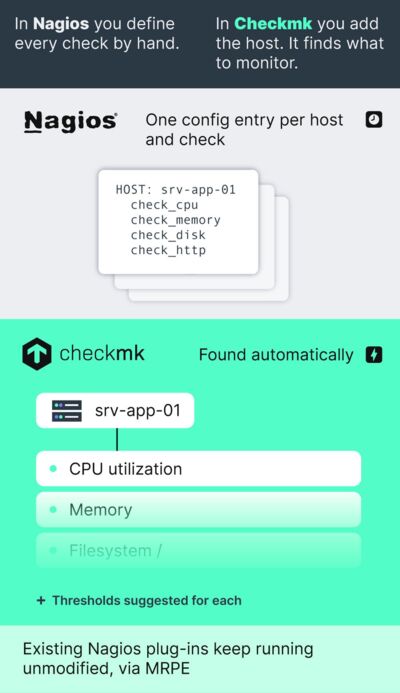
Checkmk gives you the automation, scale and central configuration that Nagios was never designed for, while keeping the plug-ins and checks you already run. Nagios was once an important standard solution for IT monitoring – however, the IT world has changed a lot over the years. Nagios no longer meets the requirements of modern IT monitoring: configuring individual systems is complex, scaling is difficult and the learning curve is steep.
Checkmk makes the switch straightforward and brings advantages Nagios can't match:
- Checkmk installs in minutes, on your own servers or in a Docker container, with no additional database or web server required.
- Checkmk takes over your Nagios hosts through bulk import or a script, and runs your existing Nagios plug-ins
- In Checkmk, you configure the whole environment centrally through the web interface, with no command line needed.
- Checkmk's Agent Bakery manages and updates monitoring agents centrally.
- Checkmk scales across hundreds of sites and 100,000+ hosts, all managed from a single central site.
- Checkmk monitors cloud-native, container and on-premises infrastructure in one platform, and takes in application metrics via OpenTelemetry.
- Checkmk integrates with ServiceNow, Jira, Slack and other enterprise applications.
Some of the vendors we support





Less time maintaining the monitoring

Checkmk gives you one web interface that brings dashboards, views and configuration together, with a global search that finds any setting and guided workflows for tasks such as adding a host or rolling out agents. When you add a host, auto-discovery lists the services it finds and suggests thresholds for them, and you accept the list as it is or pick only what you need. Rules let you configure something once and apply it to many hosts at the same time, so you no longer maintain a config file per host.
To automate the rest, the Agent Bakery builds agent packages for groups of hosts and keeps them updated automatically after the first installation. The REST API lets you script setup from your own tools, and dynamic host management creates hosts automatically, for example for cloud and container workloads that come and go.
Open source roots, commercial editions for scale
With roots in open source since 2007, Checkmk has been developed together with the open source monitoring community from the beginning. Checkmk uses the same monitoring concepts as Nagios – hosts, services, availability status, scheduled downtimes and notifications – so a Nagios team is productive from day one. Checkmk also runs your self-developed Nagios checks without changes – no matter if it is an active check or if you use NRPE. Read more about how to migrate from Nagios to Checkmk.
Checkmk has a large, active community with its own events and forum. In addition to the official plug-ins, users share and rate their own extensions on the Checkmk Exchange. Close collaboration with this community is a foundation of how Checkmk is developed.

Checkmk Community is free and fully open source. It runs a pre-configured Nagios core and performs best in environments of up to around 100 hosts. Checkmk Pro, Ultimate and Cloud run Checkmk's own Micro Core, which is up to 80% more resource efficient than Checkmk Community. Pro adds advanced analytics and reporting, powerful automation and distributed monitoring for large environments. Ultimate adds full-stack monitoring and observability, advanced cloud integrations, advanced security compliance and automated mass rollouts. Cloud delivers these capabilities as a fully hosted SaaS platform. Pricing scales with the number of services you monitor, with no per-host fees – see Checkmk pricing for details.
Scales to hundreds of sites from one central site
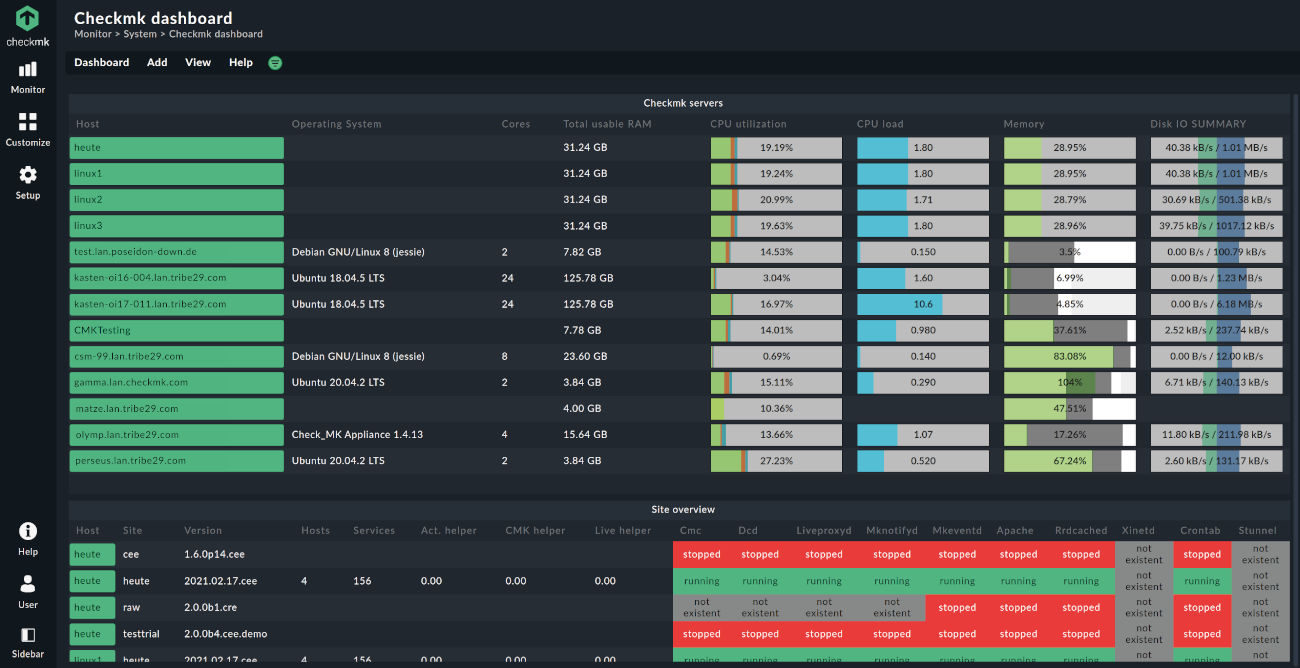
Checkmk’s Micro Core is built for large environments and runs in Pro, Ultimate and Cloud. With distributed monitoring in Pro and Ultimate, you manage hundreds of sites around the world from one central site, so you don’t have to maintain and synchronize separate instances. This is how Pro and Ultimate scale to 100,000+ hosts. For small or segmented remote locations, the lightweight Checkmk Relay in Ultimate and Cloud connects them to the central site over an outbound connection, without needing a full remote site.
Each site stays lean. The agents are lightweight and run even on small servers, and the Micro Core handles thousands of services on a single server. As a guideline, a server with 8 cores at 3.0 GHz, 48 GB RAM and a 480 GB SSD handles around 5,000 hosts and 100,000 to 150,000 services.
Broad coverage keeps the setup simple: with 2,000+ built-in integrations, Checkmk supports devices from a wide range of manufacturers out of the box.
Cloud, containers and infrastructure in one tool
Checkmk monitors Kubernetes, Docker and AWS, Azure and Google Cloud services alongside on-premises servers, networks and storage, all from one site. In Ultimate and Cloud, Checkmk also covers application observability: it takes in application metrics via OpenTelemetry, with built-in dashboards for rate, errors and duration. This puts application performance next to the infrastructure behind it, so you can follow a slowdown back to the host or service causing it, all in one platform.

Great reasons to replace Nagios with Checkmk as your monitoring tool

Easy switch from Nagios to Checkmk
Moving your Nagios environment to Checkmk takes little effort, and no prior experience with Checkmk is needed.

Modern infrastructure monitoring
Checkmk supports cloud assets,containers and Kubernetes. Thanks to its Prometheus integration and OpenTelemetry support, Checkmk is also suited to DevOps teams.

Highly scalable
Checkmk grows from one server to hundreds of sites, all managed from one central point, with the lightweight Checkmk Relay for remote locations.

Support of Nagios plug-ins
Checkmk supports all Nagios plug-ins and also comes with 2,000+ built-in integrations that are ready for use, including agents for systems such as Linux, Windows, or macOS.
I am always surprised by how easily Checkmk can be used in day-to-day operations. Especially if you are familiar with other open-source tools, Checkmk is a boon. The administration of hosts is really simple.
Trusted by global brands and local organizations worldwide


Resources
Why replace Nagios with a modern monitoring tool Checkmk Documentation Webinars
Frequently asked questions about replacing Nagios
Can I keep my existing Nagios plug-ins and checks?
Yes. Checkmk runs all Nagios plug-ins, and self-developed Nagios checks migrate without changes, whether they are active checks or use NRPE.
How do I migrate from Nagios to Checkmk without rebuilding everything at once?
Set up Checkmk next to Nagios and move your hosts over step by step. Add hosts in the web interface, import them in bulk from a CSV list, or script the transfer from Nagios via Livestatus and the REST API. Auto-discovery then finds the services on each host and proposes metrics and thresholds. Once everything runs in Checkmk, you switch Nagios off. The migration guide walks through each step.
Is Checkmk free?
Checkmk Community is free and open source under the GPLv2, and performs best in environments of up to around 100 hosts. Checkmk Pro, Ultimate and Cloud are paid editions priced by the number of services you monitor.
When is a Prometheus and Grafana stack the better fit?
Checkmk is the better fit for mixed infrastructures that need servers, network devices, storage, cloud services and containers monitored together, with checks and thresholds built in rather than assembled. A Prometheus and Grafana stack makes sense only for Kubernetes-only, developer-run environments where the team is happy to build and maintain its own exporters, dashboards and alert routing.
Ready to explore the full feature set of Checkmk?
Download the free trial and see it in action.